ENG
ENGTOP

SMART CONSTRUCTION
NEO-BEAM (Non-Removal Beam Form) Benefits
-
01
Economy
No formwork fabrication
processes required
Minimal on-site labor
through factory production
Significant reduction
in on-site indirect costs
Reduced construction costs
and shortened schedules -
02
Construction
ConvenienceReduced dismantling
processes (fewer personnel),
Alleviates shortage of
on-site storage space,
No on-site fabrication required,
Zone-based quantity management
for on-site installation -
03
Safety
Reduced accidents due to
eliminated dismantling work
NEO-BEAM remaining
in place provides
structural reinforcement effect
Equipment-assisted installation
reduces on-site manpower -
04
Assured
Construction QualityExcellent workability, durability,
and weather resistance
Uniform concrete cover
thickness achievable
NEO-BEAM ribs
can replace rebar spacers,
ensuring rebar placement quality -
05
Eco-friendliness
Reduced stripping processes
reduced construction noise and dusts
Minimized constructions
waste enabling a low-carbon,s
eco-friendly method
01. Economic Effects
-

No need for
formwork fabrication
process
Factory pre-production
allows minimal
on-site staffing
Significant reduction
in on-site
indirect costs
Construction
cost savings
Schedule shortening
-
Construction cost savings and schedule shortening
· Material and labor cost savings via factory pre-production and reduced material loss
Time Savings
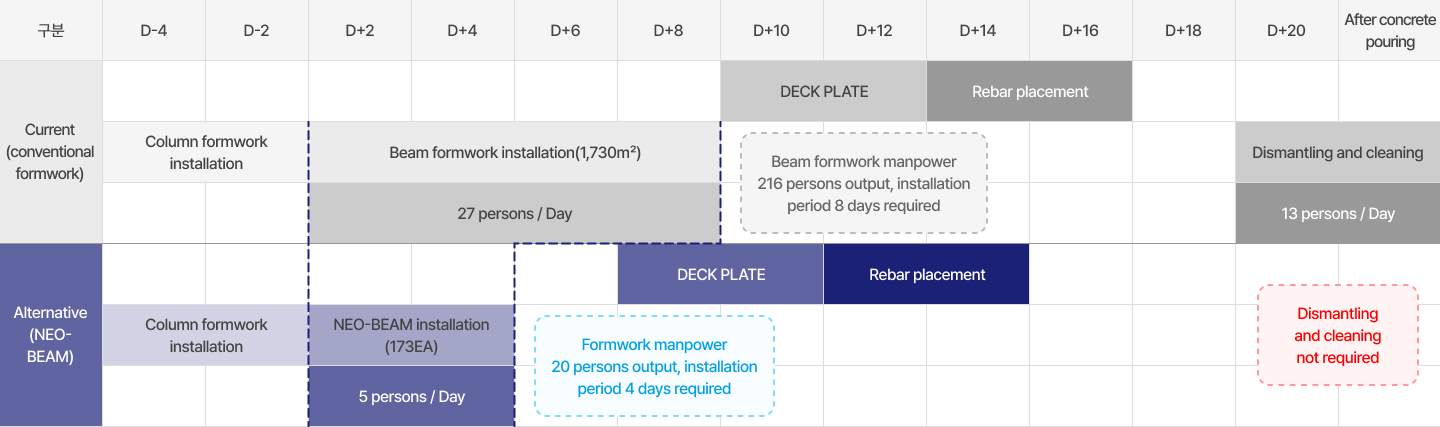
· Applying NEO-BEAM can shorten overall construction schedule by approximately 25%, and for beam work up to 50% reduction.
· Simultaneous fabrication and installation further compress schedules.
· Minimizes use of wooden formwork consumables.


NEO-BEAM Process & Labor Input Comparison.
*detailed numerical table omitted in this translation to preserve readability — full table data can be provided in tabular format if required
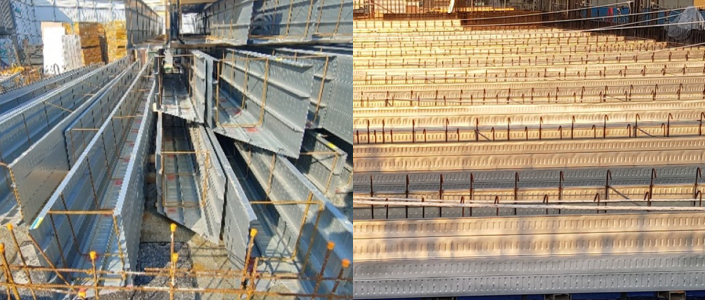
02. Construction Convenience (continued)
-

On-site installation quantity management by zone (minimizes storage space)
-

No stripping process — personnel minimized
-

No waste generation — improved site cleanliness
-

The most difficult construction section in conventional construction methods is
now constructed using NEO-BEAM
-

Applicable Column Pre-pour Methods
-
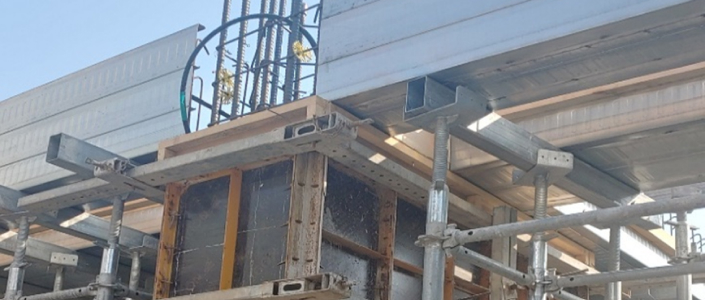
Pre-pouring of columns: compatible with NEO-BEAM
Simultaneous column pouring: compatible with NEO-BEAM
03. Safety
-
-

-
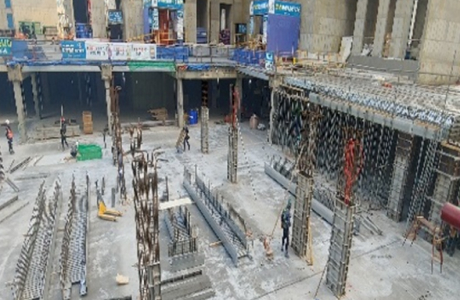
No need for formwork removal reduces accident rates
-
-
-

-
Equipment-assisted installation reduces on-site manpower
-
-
-

-
Lower manpower reduces accident occurrence
-


04. Construction Quality Assurance
-
-
-

-
NEO-BEAM ribs act as rebar spacers,
ensuring rebar placement quality
-
-
-

-
Uniform concrete cover thickness achievable for rebar
-
-
-

-
Hot-dip galvanized steel plate (KSD3506-GI) and POSMAC neutral salt spray tests performed
-
-
-
When Using NEO-BEAM, Spacers Are Unnecessary
· The ribs of NEO-BEAM act as concrete spacers so
that uniform rebar cover thickness is possible.Durability & Corrosion Resistance
· Hot-dip galvanized steel plate (KSD3506-GI) and POSMAC neutral salt spray tests performed


05. Eco-friendly
-
-

-
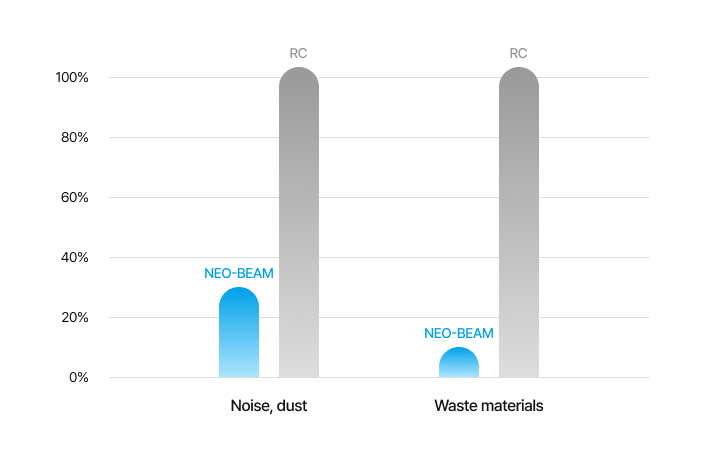
Factory-precast production reduces noise and dust on site, enabling a pleasant working environment.
-
-
-

-
Minimizes construction waste and reduces CO₂ emissions, enabling a low-carbon eco-friendly construction method.
-

NEO-BEAM vs. Conventional Wooden Beam Form — Comparison Table
| Category | Conventional RC Wooden Formwork | NEO-BEAM (Non-Removal Beam Form) |
|---|---|---|
| Pre-construction coordination | Requires extensive pre-work coordination | Applicable to RC structures at any time |
| Material inspection | Complex reuse inspection, formwork coating, yard management | No material reuse inspection or verification procedures |
| Required manpower (per 300㎡/day) |
40+ carpenters | 4–6 carpenters |
| Shoring installation | Full shoring installed simultaneously with beams | 30% pre-installation remaining 70% added before casting |
| Stripping work | Mandatory high accident incidence during removal | Non-removal no stripping work |
| Post-curing tasks | Inspection and reuse processing required | No separate inspection required remains as part of structure |
| Rain response | Material damage risk; may prevent delivery | Deliveries may be delayed; schedule can be flexibly adjusted |
| Site footprint | Large material storage hinders passageways | Minimal materials efficient workspace |
| Safety | High accident risk during removal | Lower safety risk due to non-removal method |
| Environmental impact | Heavy use of hammers, high noise, dust, large waste output | Low noise, low dust, minimal waste |
| Conclusion | High cost / high risk / high manpower quality drop due to foreign worker mix | Schedule reduced (avg. 30%–50%), labor cost reduced (80%–90%); improved safety and economics; lower union impact |
NEO-BEAM Delivery & Standard Forms
Strut Types: U-type strut and HOOK-type strut can be applied (subject to contractor-supplied processed rebar conditions).
Welded Strut Installation: For ease of worker movement and rebar placement, U-shaped strut geometry is maintained and HD13 support struts are welded for lateral pressure resistance.
Hook-type Full-weld Option: To minimize field labor for strut installation, HOOK-type struts can be full-welded at rebar assembly.

For shape stability: install at intervals less than or equal to 500mm (remaining struts are part of the RC rebar works).

Standard NEO-BEAM delivery form
(rebar arrangement according to specification list)

Safety Note: For members with W ≤ 600mm, extra care is required when using HOOK-type struts.
On-site Rebar Placement Sequence
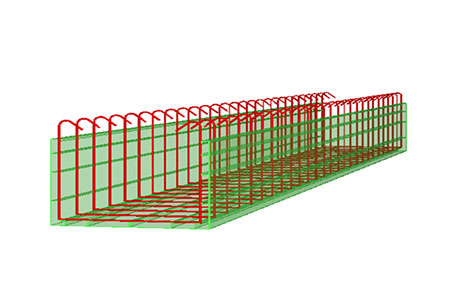
NEO-BEAM installation

On-site rebar placement
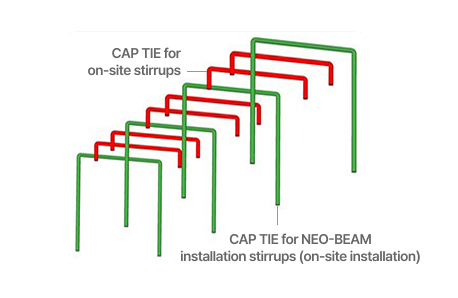
Strut cap tie placement
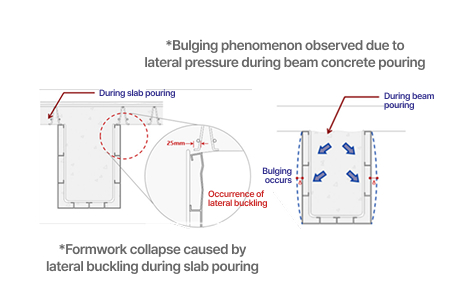
Installation of Lateral Pressure Hardware
Function
Prevents warping of side plates and slab deflection during concrete casting; must be fixed at designated locations.


Plywood forms
-
Before construction

-


-
After construction
Plywood formwork at column joint Plywood formwork at retaining wall–column joint
Corner plates
* separate quotation required
-
Before construction

-
-
After construction
Construction Example 1 Construction Example 2
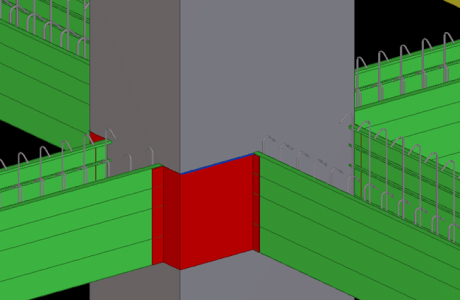 Construction Example 3
 Construction Example 4>
Transfer Beam (TG beam)

Factory fabricated

On-site installation
End Plate & Cantilever Region
* separate quotation required


NEO-BEAM installation at end cantilever zones
Installation clearance
* separate quotation required